
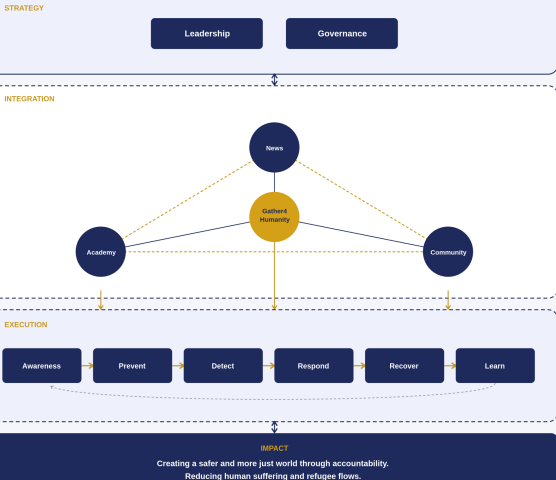
solutions
Access
All (young) professionals and partners gain from having full access to validated information and best-practices.
Mandates, focus, effieciency, effectiveness
(Young) professionals and partners suffer from limited resources due to ad hoc funding, overtime different (political) priorities, time consuming individual and case-driven orientation, and non-sustainable businesscases.
Multidisciplinary cooperation
Addressing (perpetrators of) core international crimes is difficult. The industry is highly ad hoc, institutional, judicial, closed and its approach is content driven and academic. Trust, mandates, mutual understanding, political agendas and other judicial and practical obstacles to cooperation leave unexplored the full potential of cross sector approaches by the public sector, private sector, academic sector and civil society (organisations). Also the triangle between prosecution, police investigators and border- and migration authorities could be strenghtened.
Co-creation
Traditional and formal organizations, (young) professionals and partners benefit from outsourcing their secondary tasks and investing in the overwhelming potential of crowdsourcing, wisdom of the crowd and co-creation.
Advocacy
Advocating, teaching and otherwise disseminating standards of international humanitarian law and international criminal law. furthering tools and mechanisms to prevent and monitor core international crimes, including early warnings systems.
Challenges
ACCESS
Multidisciplinary cooperation
Co-creation
Advocacy